Saturday, October 9, 2010

The birds and the bees and the flowers and the trees and a thing called love

As our kind friends and followers keep telling us, we haven't posted a blog in a long time. Why, you ask? Well, our wedding recently took over our lives! We were married at our home on September 25th with our immediate family and close friends in attendance. The bees played an important role as you will see.  It was a fantastic day that we will always remember happily.
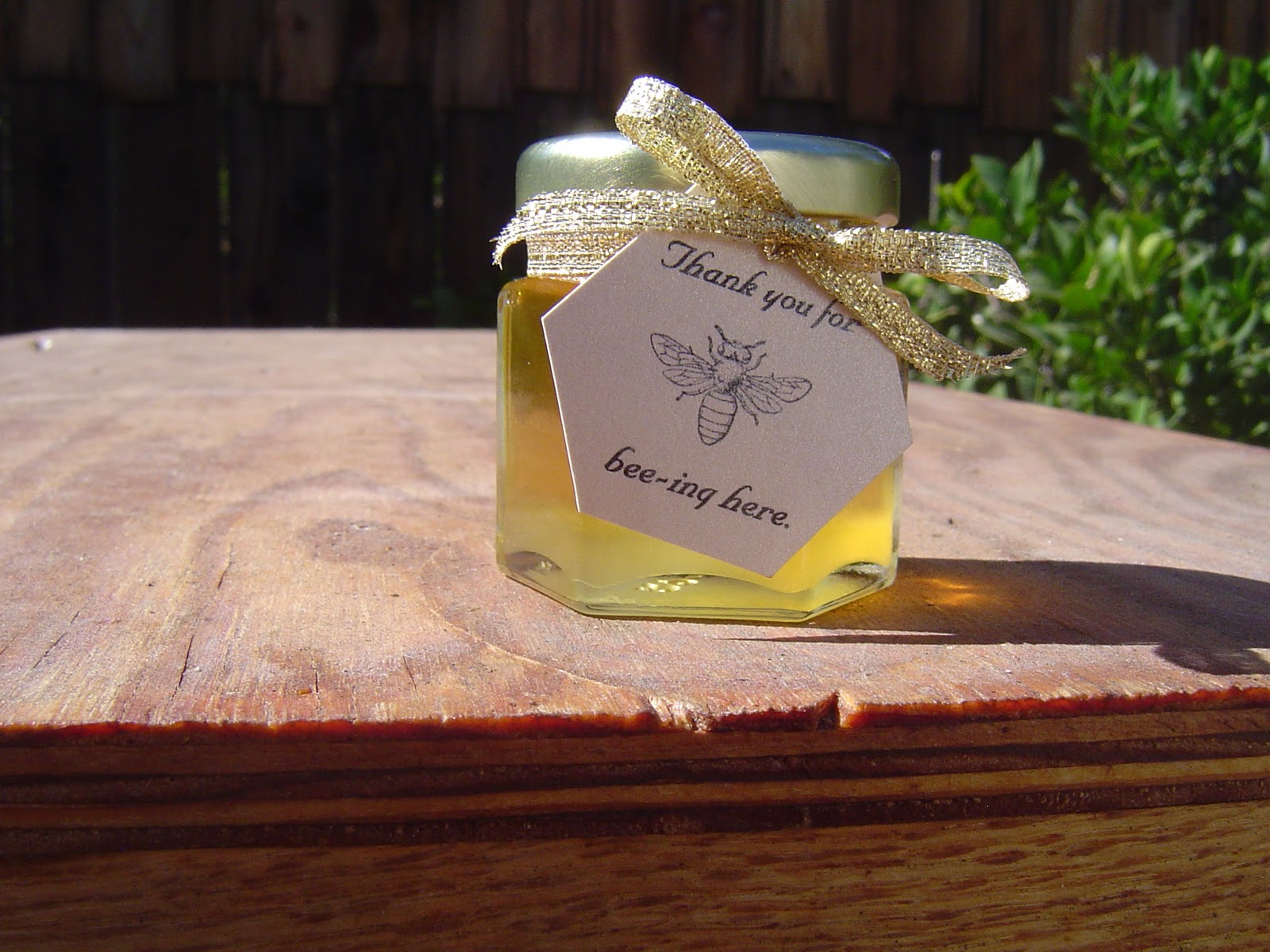
The bees and Tim co-produced our wedding favors!
Our good friend, Kari made this gorgeous cake with
bee and gold-leaf accents
It was so beautiful--we hated to cut it--but it was delicious
too, so I'm glad we did!
A gift of something new and something blue. There was
old and borrowed too, but not bee-themed!
My sisters created this incredibly cute bachelorette favor.
Honey-flavored candy filled the champagne flute.
There is a lot of talent among our friends. Adam and Emily
 made this lovely bee painting that they gave us as a wedding gift!

Sunday, August 22, 2010

Harvest

We harvested two 'frames' of capped honey from the TBH about a week ago. It was medium colored and super sweet (tooth-ache sweet) with the distinct but subtle flavor of licorice. Everyone who tries it takes a taste, stops for a moment, gets this confused look on their face and then says, 'there's something different about this honey...I can't quite place it.' They either eventually realize it tastes like licorice, or when we tell them that's the flavor, they go 'yeah, that's it!' We harvested a couple of quarts.

And now I am rendering the wax. Hard work. I bought a crock pot yesterday ($7 at Saint Vincent De Paul. It's the cool, yellow old-school one my mom had.) and pitcher to use expressly for wax rendering. I'm starting with a double boiler, which will allow me to skim the melted wax off the top of a pot full of water and other gunk. The next step will be to re-melt the wax in my way-cool retro crock pot and then pour it through some paper towels to sift off the remaining gunk. This is hard work for just a few ounces of wax from several combs.

Word on the street is that you should only try rendering wax from cappings--the thin, pure-ish wax the bees use to cover the fully cured honey for storage. I think that's probably a better idea. But hey, we never do things the easy way, and it seems a real shame to throw out all of the honey comb.

Saturday, August 7, 2010

Bee Brethren: The Mud Dauber

At the beginning of the summer, I noticed a mud dauber (this guy ) building a nest under our patio cover. I was a little aprehensive about her being there because, well because look at that thing; she looks like a stinging machine! I could just imagine a nest bursting forth with hundreds of stinging machines later in the year. But it was fascinating to watch her build the nest. She would collect mud and then plaster it into the corner of the patio, building clusters of long, narrow cells. Each day she would add one new cell. Sometimes the cells were capped and sometime open.

Intrigued, I did a little research online to find out if mud daubers have any redeeming qualities; I really don't like killing things if I can help it, but I was a little worried that the wasps might bother the bees, not to mention my friends and family! My research revealed that mud daubers build these cells and then fill them with dead insects to eat later, not baby mud daubers. Another article indicated that honey bees are too big to be a major source of food for them. And since the wasp wasn't the slightest bit interested in me, I decided she could stay. 

I haven't seen her now in months. And until today, when we decided to remove the nest and dissect it, it looked exactly as it had before she disappeared. I sometimes wondered what had happened to her, but not enough to think that the food she put into the nest might not have been for her! Tim carefully cut down the nest and we gingerly cut it open, removing bits of brittle mud plaster to reveal little caches of long-dead spiders and some sort of cocoon. As I started to cut away another chunk of the nest, I heard a violent buzzing and saw something brown and amber colored wiggling around just under where I had made my cut. 

I don't think I've ever moved so fast! I was away from our dissecting table and across the patio in a fraction of a second, screaming my head off like a maniac all the way. (Odd that Tim thinks I'm too jumpy to make a good entomologist.) 

Let me now set the record straight: mud dauber nests are full of baby mud daubers! The mother builds a mud tunnel, fills it with snacks, lays an egg in it, covers the entrance for extra coziness and then makes a get away. The babies grow fat eating the dead insects, spin cocoons and then emerge as full-grown mud daubers. The one that we watched emerge this morning, chewed her way out of the mud tunnel and immediately took flight. She made one circle of the patio and then flew off without so much as a glance back.

Not to worry friends, fascinating as they are, we are not about to get into mud-dauber keeping.

Tuesday, August 3, 2010

There's honey, Honey!

When we didn't have any capped honey by mid-July, I started to worry that we wouldn't get any, which I found surprisingly disappointing. I'm into beekeeping because it provides me an opportunity to observe insects up-close-and-personal. Honey is a bonus. Nevertheless I was disappointed, partly because I thought it meant I was doing something wrong.

Well, if the amount of honey in a hive directly correlates to the skill of a beekeeper, Tim and I are beekeeping extraordinaires. According to Tim, who is chivalrously holding down the fort while I'm on travel this week, the TBH has several combs of capped honey!

I'm ecstatic.

Sunday, August 1, 2010

Combo the Combo Hive

Today we combined the remaining bees in the combo hive with the Langstroth colony that was originally split from it earlier this summer.

Several weeks ago, I noticed that the combo hive, which was the strongest of our spring swarms, was building lots of swarm cells. In an effort to stop or decrease the swarming, I split the hive into a Langstroth. (By the way, this never works; once a colony makes swarm cells, it's gonna swarm.) The remaining combo hive 'swarmed itself silly'--a technical term I invented to describe a colony that has swarmed repeatedly until it has too few adult bees to care for the brood.

When we checked the combo hive today, there were just a couple of combs of bees. There was larva and capped brood, so we knew there was a laying queen, or at least that there had been fairly recently. The numbers of bees had dwindled to the point where I couldn't really see the hive surviving; just a few bees went in and out of the hive in a 15-second period.

So, we combined the combo and Langstroth colonies using the newspaper method. Simply put, you consolidate all of the bees from the strong colony into one deep, then you place a newspaper with slits in it over the top bars of said deep, and finally, you place a second deep containing the combs and bees from the weak hive on top. The idea is that the bees on both sides of the newspaper will eat their way through, getting used to each others scent as they go, and be best of friends by the time they come out on the other side.

We'll check on the bees again next weekend and let you know how they're doing.

Saturday, July 17, 2010

Bee Date

Today friends from work and their children came to visit the bees. There were 8 kids ranging from 9 months to 8 years old, and all of them were very enthusiastic about bees. We talked a little bit about how important and special honey bees are and then we took a peek inside of the bee hive. I was so impressed with how brave and curious all of the kids were. Afterward, we tasted honey from both of our hives. Interestingly, the TBH honey tastes like licorice! I'm attributing the flavor to the wild fennel growing in the creek.

All in all, a truly fantastic day!

Future Beekeepers of America!
All suited up and ready to see some bees!
Warming up with a peek through the viewing window on the top bar hive
The first glimpse of the triangular top bar honey comb
A closer look at the bees and honey comb. Lots of great questions!
Finally, we got to taste some honey!

Sunday, July 4, 2010

Anna's Bee World

I stumbled across this truly fabulous native bee blog today: Anna's Bee World. Check it out!

Wednesday, June 30, 2010

Busy Bees

When I got home from work today around 4:45, the TBH bees were going crazy! It looked almost swarm-like, but I noticed that as many bees were going into the hive as coming out, which made me feel better. I went to the grocery store, and when I returned, things had really slowed down--just a few bees going in and out. I couldn't find a swarm in any of the trees nearby, and when I looked through the viewing window, it was just as full of bees as ever.

Monday, June 28, 2010

Your Guess is as Good as Mine

I went outside this morning to say hello to the bees, and I found a group of them dangling from the hive! I can't figure out what they were up to. Maybe this is how bees play?

Sunday, June 27, 2010

Starting over

Well, the combo hive swarmed and now they are starting over again. When I arrived today, the usually bustling hive was trickling bees in and out, and when I opened it up, bees scantly covered only about 6 of the 12 filled out frames. Everyone was a little touchy too.

I found a queen on about the fifth frame. She looks nice and fat, and I hope she will get down to laying soon and preferably not exhibit the swarminess of her mother. Time will tell. I don't think we will be getting much honey from this hive, but hopefully they will be able to build up enough to make it through the winter.

I think the split from the combo hive ended up with the old queen because there was never a break in the brood cycle. I'm wondering if we should re-queen to prevent massive swarming in the future. While those of you who know me know I'm not in this thing for the honey, it would still be nice to get a little bit to share with friends and family instead of more bees, which I really don't need or have room for. Tricky!

The TBH is building like crazy. I added two more frames this week. The brood is still patchy, but the bees seem to be okay with that--there are no signs of supercedure--so I'm okay with that. They have loads of pollen stored but still not much honey.

Saturday, June 19, 2010

TBH Observations.

The TBH now has 19 frames! About 18 of those are at various stages of being drawn out. I added two frames today--one with a small lobe of wax that was built by the previous denizens of the hive and one completely empty. I've been adding frames to both ends of the hive over the last few weeks, and they are happy to work them on both ends, but they store different things at the extremes of the hive.

To the left of the hive, they tend to store honey and brood. To the right it's all pollen and drone brood. They have a lot of pollen--probably 5 solid frames of it, but not much honey. Drone production seems to be slowing down now.

The queen isn't the tidiest egg layer. She tends to spread things out a bit, especially on the drone brood--a few drones here, some honey there. The worker brood is pretty regular, although it seems to be at various stages of development; eggs, next to larva, next to capped brood.

I've noticed more propolis in this hive than in the others. I'm not sure if that has to do with it being a TBH or if they are just heavy propolizers--it doesn't make things impossible, but I do spend time scraping it off so that I can move the bars more easily.

I noticed a couple of supersedure cells today--maybe the workers aren't happy with their queen's performance. Personally, I like her--she's completely black, which makes her easy to spot--I see her pretty much every time I'm in that hive. She seems to have put on some girth over the last few weeks and now seems bigger than when she first arrived. I wonder if she could possibly be a new queen.

Finally, I've noticed a red dragonfly loitering around the hive and occassionally flying through the little cloud of bees at the entrance. It doesn't seem to be eating the bees, but I do wonder why it is attracted to them.

Sunday, June 13, 2010

Very mysterious

Temperatures have been creeping up over the last few days. Yesterday at 4:00pm my backyard thermometer read 100, and at 10:30 this morning as I was getting ready to open the TBH, the thermometer read 90!

As I was preparing the smoker, I noticed a very dark, large bee frantically running around among the weeds. At first I thought it was a drone, but on closer inspection, I determined that it was a virgin queen.  She was much larger than a normal worker, with a pronounced thorax, and her abdomen ended in a point. Since, I didn't know what she was up to, I decided not to disturb her.

When I opened the hive, I found the old queen looking quite healthy on the 5th frame and a happily buzzing colony. They've now filled out about 12 frames, mostly with brood. I added a frame on either end to give them something to work with. There was a lot of propolis between the top bars and the hive walls, and the hive gave off the distinct smell of propolis when I opened it.  Not much honey in this hive yet, but much of their small stores are mixed in among the brood comb. Odd.

I am baffled by the virgin queen...was she on her way to get mated? Was she returning from a mating flight? Did the bees kick her out because the reigning queen is still in good shape? Did the reigning queen kick her out? So many questions!

Thursday, June 10, 2010

Hurt So Good

I got stung on the thigh today, and it swelled up to the size of a softball! I didn't tuck my pants into my socks, and one of the girls crawled up the inside of my pant leg and showed me who was boss. Ouch! It's my first real reaction to a sting since taking up with the bees.

It hurt, but harvesting my first frame of honey more than made up for it! The gals had drawn out a frame of wax and just kept extending the cells on one side into the empty frame next door. I wasn't sure how to fix it without making a big mess, so I decided to harvest it. The bees seem to be finding plenty of nectar and pollen, so I didn't think they would miss it.

The frame was about 3/4 drawn out and capped on one side; it yielded about 3 quarts of honey! Most of it I crushed to extract the honey, but I left some of the wax intact because in my opinion, squishing the honey out of the wax into your mouth is the best way to eat honey. I'm also working on purifying some wax to make candles or lip balm.

Putting the drawn out frame into the brood chamber and creating a nuc seems to have prevented a swarm, for now anyway. I put the nuc into an eight frame Langstroth today with a follower board to keep everyone nice and snug. I'll be keeping an eye on that hive to see how things progress over the next few weeks. Hopefully we'll see some eggs soon!

Thursday, June 3, 2010

Experimentation

I checked on the combo hive today, and I found about 10 swarm cells in various stages of development. Tim and I discussed what to do about it last week when I first noticed the bees starting to build swarm cells, and we half decided to just let them swarm. However, I was concerned about that for a couple of reasons; first, they might swarm themselves silly like the 'Old Hive' tried to do, and second, I don't want them swarming around the property where they are located--having a swarm of bees settle into the property owners' wall hardly seems like a nice way to say thank you for letting me keep bees there.

Most of the swarm cells, even ones that were pretty well built out seemed empty, so perhaps these are back up cells that the bees will only populate in an emergency?? There were a couple of capped swarm cells; one I left with the main hive, and the other I put into a split.

I also put a fully drawn out frame into the middle of the brood nest of the parent hive to give the bees a sense of having lots of space and maybe curb the swarming urge.

I tasted royal jelly today. I thought it would be sweet, but it was actually kind of salty with the distinct, earthy flavor of a bee hive.

The GOOD NEWS: There were two full frames of honey! Go bees, go! Having said that, the bees have slowed down wax production--they only filled a total of about one frame since my last inspection.

I am curious to see if putting the empty comb into the brood nest helps with the swarming. We shall see.

Wednesday, May 26, 2010

BBC News

There was a article in the BBC News today about bees and colony collapse disorder. Here's the link if you are interested....